Monday, 16 March 2020

Focusing Inquiry for 2020

I have been thinking a lot over the past 3 months about my inquiry from last year. How much I learned as a teacher and the shifts I saw in the children's attitudes and ability.

What I know for sure is that there is so much more I need to learn. So much more value I could be bring to my classroom to address the gaps in vocabulary. As I began to discuss this with others in my school I released that I needed to maintain the literacy focus in had in 2019 and build on this.

I began to read the wonderful book by Dr Jannie van Hees and Paul Nation- What every primary school teacher should know about vocabulary.
Image result for What every primary school teacher should know about vocabulary.

This a long with discussion with my SMT team and teaching colleges helped me to develop my questions that will guide my thinking around my inquiry this year leading from reading to oral language and hopefully into written language as the year progress.

Will increase discussion between learners and deliberate acts of teaching vocabulary improve achievement across multiple curriculum areas? 

My plan is to be more specific in my thinking, planning and implementation of my intervention this year giving my approach more time to work.

Friday, 13 March 2020

Looking Back and Taking Stock

#1... Use the ‘inquiry stocktake’ doc to reflect on and write about what you aim to learn about inquiry this year.

As we start to think more about 2020 and our teacher inquiry it is important to look back and ask, how well did I inquire last year. In this process I began to think about the planning for inquiry and the process of recording the changes I made. I also though about all the good intentions I had that didn't become reality.

Having been sick for the CoL meeting I spent a great deal of time looking at the Stocktake doc and thinking about what applied to me and how this could help me move forward in 2020.

Image result for teaching as inquiry

What worked well in 2019
In 2019 I developed a lot of ideas and tried a lot of things which gave lots of diversity in practice and learning opportunities. I had great success in reading and found that learner could rise to the high expectations and absorb a lot of new vocabulary in this area.

My Challenges in 2019
My biggest challenge was consistency in my approach and giving things time to work. I think this was due to a lack of forward planning at the beginning of my inquiry. While I did a lot of research I didn't have a clear vision for my class and when I believed something was not working I changed it possibly without enough hard evidence.

I also found the challenge of time. In my CoL across school role I am out of the classroom 2 day a week and this can also lead to a lack of consistency in my room.

The Support I need in 2020
I am going to reach out to other teachers and members of the Woolf Fisher research team and the Manaiakalani team to help me connect with effective practice in reading specifically around dialogic discussion and vocabulary. I want to have a clear idea of where I am heading before I leap in. I also want to have a strong foundation in research and more check point which I will need help developing and implementing as this will give me a richer picture of student achievement.


Friday, 6 March 2020

Manaiakalani Class Onair

This year I am continuing my role as a Manaiakalani Class Onair teacher. I am excited to keep sharing the learning that takes place in my classroom and extend on my won learning through watching myself teach on video and hearing feedback from teachers. 


This video shares a bit more about what you will see on my Manaiakalani Class Onair page.

There are many amazing teachers taking part in Manaiakalani Class Onair this year and many teacher who have contributed in the passed. You will find episodes ranging from year 1 to year 13 in many curriculum areas.

Here is a link to the site. I hope you will visit.

Friday, 14 February 2020

Focusing Inquiry 2020

My 2020 CoL Inquiry Focus:
Will increase discussion between learners and deliberate acts of teaching vocabulary improve achievement across multiple curriculum areas?

Manaiakalani Community of Learning is working together on this task using the expertise existing in of our community of learning. I have selected the achievement challenge of:

Lift the achievement in Reading for all students, with a particular focus on boys and Māori students (both genders) years 1-13
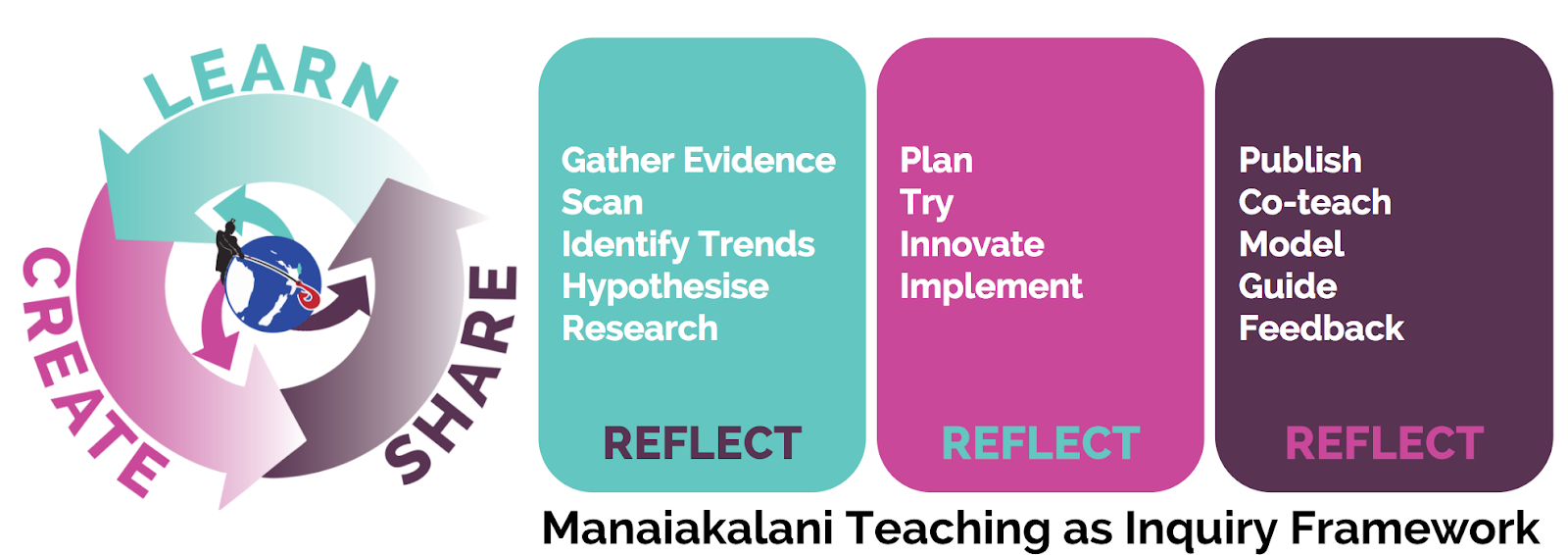
The teaching as inquiry framework I will continue to use in 2020 has been specifically co-constructed for Manaiakalani schools using our familiar Learn Create Share structure.


Throughout the year, I will be labelling my blog posts to reflect our Learn, Create, Share structure.


LEvidence
Learn - Gather Evidence
CPlan
Create - Make a plan
SPublish
Share - Publish
LScan
Learn - Scan
CTry
Create - Try new things
SCoteach
Share - Co-teach
LTrend
Learn - Identify Trends
CInnovate
Create - Innovate
SModel
Share - Model
LHypothesise
Learn - Hypothesise
CImplement
Create - Implement
SGuide
Share - Guide
LResearch
Learn - Research
CReflect
Create - Reflect
SFback
Share - Feedback
LReflect
Learn - Reflect


SReflect
Share - Reflect

Wednesday, 29 January 2020

Maths, So what?


If we think about Maths and what we have been doing. Do we feel it is achieving all we want for our learners?
Many of our learners need physical materials to connect with the problems they are facing and teacher scaffolding to understand how to use these materials.


We want to maintain all the good things we have learnt in the last 2 years in DMiC the use of open, challenging problems but develop more scaffolding, structure and connection to the progressions. 
As we look into this more we will develop a stronger picture of all the curriculum levels and what it means when creating an OTJ for learners. 

We had many positive things from DMiC:
The power of group norms for all learning areas. 
We were challenges about culturally responsive practice.
We were challenged about the view of ability groups. But we must remember that it is not all or nothing. We must remember to think about who could belong well with whom and work well with whom. We want children to experience working in many different ways. 

Now that we have things that we know work we need to have a scope and sequence for our learning. After looking at the many the team leaders and SMT decided we would use these New Zealand Curriculum Maths Connecting all the Strands. 


Beginning 2020: Never Lose Hope


Russell began the day telling us about his first day and Pt England School and how different the school is now. How much everyone cares and the amount of time everyone has spent making sure we are ready to jump into learning on day one. 


What do we need most in 2020?
This is a question we ask every year and what a big question it is. As we spend two days working together to develop, plan and focus on teaching and learning together. 

It is very exciting that this year we will be using the resources from inside the school and learning more from the experts in our own school. We will be focusing on Math, Reading and of course the Pt England Way.  We will focus in terms 1 and 2 on Maths and terms 3 & 4 on reading. 

We have a school wide focus of "Never lose Hope". We want our community to have hopes and dreams that drive them. We want them to set goals, have aspirations for the future and find what they love.  It is about seeing the value you have and bring to a group. This is a value that we as teacher, our whanau and the children see as important.

How do we plan in these values? Planning and teaching behaviour is important. 


Thursday, 21 November 2019

Bursts and Bubble Reflecting on my inquiry

I am excited to share my inquiry in 3 minutes at our Bursts and Bubbles. Thought, Idea, Innovation, Imagination, Inspiration


The catalytic aspect of student learning for my inquiry was gifting vocabulary across my literacy program in an effort to increase overall literacy achievement for my learners.


I identified this as my focus when I noticed that while the cluster wide and school wide data showed a need to focus on improving reading many of the learner in my learning space were struggling writer coming into year 3 writing at a 1B level.


The sources of evidence and data I used were from both the areas of interest for me and my learners. I used Star Reading data, Running records, e-asstle writing data, samples of writing taken from the learners writing books as well as my own observational notes of students reading and writing behaviours.

The main patterns of student learning I identified in the profiling phase were that learners were writing very short stories that were lacking in the areas of ideas and organisation. They also struggled with decoding in reading with all 11 learners in my target groups reading at a year 1 level. While they were eager learners they often struggled to get started and to attempt unknown words in both reading and writing.


My profiling of my own teaching looking back at previous years data showed that I made  good progress in reading using my current approach. I noted however that when teaching writing I was not gifting the amount of language I suspected was enough to support vocabulary acquisition and retention in reading or writing.  This led me to think carefully about the gifting process in my teaching when the introduction of texts for reading, engaging learners in a writing experience and throughout the writing process.


The changes I made in my teaching were carefully selecting language when introducing learners to their texts in reading. I also worked on intentionally gifting language throughout the writing process and making this rewindable the use of audio clips in the explain thing activities. During my implementation I notice that writing was still short and that sight word writing was holding learners back. This is when I worked on building automaticity of sight words in context.


The literature/expertise that mostly helped me decide what changes to make were looking back at the inquiries in this area conducted by others in the past. I also drew on the professional learning from Jannie Van Hees and took the ideas she shared in CoL meeting and team meeting into my practice.


Overall I would rate the changes in student learning as interesting The evidence for this is that student achievement in reading was great with all but 2 learners making over a years progress and 2 learners making over 2 years progress. This is significant for these learners when compared their progress in previous year. While learners writing length increase this did not translate into shifts in writing level on the e-asttle test. I wonder if more regularity in implementation of approach would change the impact.