Showing posts with label Inquiry 2023. Show all posts

Saturday, 17 June 2023

Where are you at?

 For every inquiry it is important to know where the children are at and how the children are working. 

As part we gathered data in term 2 to understand not only where children are working in terms of number knowledge but also how they can apply this in strand. 

It again confirmed that for my learners at year 4 there is a wide spread of knowledge and gaps that has a huge impact on children. On way in which we did this was by using e-asstle tests to provide a picture of where children were at. I read the questions when needed so that did not impact the test results. 


Thursday, 15 June 2023

What we think Children...

As part of my Inquiry I worked with Hannah and Danni to create surveys for the learners,  Leadership team and children about maths at our school. 

By far the most interesting and influential of the surveys was reading what the kids had to say about their maths. 

What I found interesting was the level of recognition they had about their strengths and needs. Many identified the need for more times table knowledge and the attitudes of learner in maths were very different from the completely positive view the children had when we did a reading survey earlier in the term. 

I appreciated the honesty that come through when the children wrote about what they wanted their teacher to know. 

Below are the results from the Child Survey found here


Thursday, 8 June 2023

What we think teachers...

As part of my Inquiry I worked with Hannah and Danni to create surveys for the learners,  Leadership team and children about maths at our school. 

It has been interesting to see what the teachers think are the key areas of need and to read descriptions of what is happening in each year level. 

What I found most interesting was that well teachers felt they were teaching basic facts with a whole class approach through song, movement, Xtramath, Mathwhizz. It was also an area in which they felt there was a big need for children that wasn't being addressed. 

They also mentioned the different between strand and number knowledge teaching and the pressure this creates for doing everything well which was similarly mentioned in the SMT survey. 

What I liked and appreciated about this was the clear links to what the children thought about their maths (although these were only year 4 learners) and what the teachers noticed as needs.  

Below are the results from the Teachers Survey found here


Friday, 2 June 2023

Causal Chain, So what?

 This year I have been looking at what I can do to support learners in maths when they have a varying degree of knowledge, skill and understanding. 

How do I make this fun and what do I need to do as a teacher to know the issue, where to and what next? 

This is what I have come up with so far. 

Thursday, 1 June 2023

What do you think SMT...

 As part of my Inquiry I worked with Hannah and Danni to create surveys for the learners,  Leadership team and children about maths at our school. 

Looking at the results has given me an interesting preceptive on what are believed to be shared challenges across the school and what are challenges that only the children identified. 

Below are the results from the Leadership Survey found here

The first view I wanted to share was that from one of our management team. I share that basic facts, place value and foundation teaching are strength, well more consistency, earlier teaching of multiplication and teacher knowledge building are gaps that we need to work on improving. 


Friday, 17 March 2023

Finding Out More

 To understand more about the school-wide problem of mathematics we worked collaboratively together to create three surveys. These Surveys looked at teacher opinions and thoughts about mathematics. The thoughts of the senior management team about mathematics and our school. Most importantly for me what the children felt they're learning in mathematics and how important it is to them. By collecting this data we are getting more perspectives and understanding the problem from a range of point to point of view.

Survey for Senior Management

Surevy for teacher: Surevy for Children:

Friday, 10 March 2023

Thinking about the problem

The challenge in student learning that I have identified for this inquiry is the ranging abilities in maths and how do we address these within the classroom setting while drawing the strength of all students. 


This is important to me because initial testing with the children along with Manaiakalani data has shown that there is an increasing gap between the ability of children in mathematics.  This is representative of the wider issues in New Zealand education. Overall this leads to a problem of data suggesting that children are failing in mathematics when in fact what I've noticed in my classroom is that many children are excelling in particular areas of mathematics while others are struggling in the same areas.

Over the years many teachers have identified the complexity of language in mathematics and have explored this in their inquiries. Over the past few years Manaiakalani has identified a shared pedagogy for reading and writing. At the school we are aware of the increasing challenge and catering to all students in mathematics and making sure that learning in mathematics is accelerated over the year. As such, Danni Stone, Hannah West and I have come together to think about the way in which we can accelerate mathematics by using opportunities for extension groups and collaboration within the classroom. 

Our initial plan: In her role as creative space teacher Hannah has the opportunity to pull children out and work with them on specific targeted projects which will allow them to accelerate. As such we have discussed that she may take out a group of extension children from year three and four to work on their gaps and push them to think creatively in mathematics. From this wonderful opportunity I hope to draw what she is doing in her extension program and look at ways to create collaboration within my maths classroom. I believe that there is a real need for children to be aware of their gaps and strengths and how these can be developed over the year.

 I wish to include more assessment and discussion with children about their learning and gaps in order to make sure that they are able to fully understand their next steps. At this stage in my inquiry I'm looking at gathering data to fully understand each child's gabs and strength and formulate a plan for sharing these with the children in a way that is meaningful. Look forward to continuing to collaborate in this inquiry and hope it will provide a way forward for maths in a diverse classroom.


Thursday, 9 March 2023

Chit Chat about Math

We discussed a number of challenges that we felt were important to student learning and I've left of these below.


- Children having a range of knowledge but not being able to apply it correctly.

- Children revert to early number strategies as these are the most prominent in their brain even though they have more effective ways of solving problems.

-Children having gaps in knowledge either from Covid or from not retaining knowledge from previous years.

- Children not understanding how they can move onto the next step in their learning.

- Children not having the self-confidence or self-efficacy to learn from others and apply that learning in different contexts.


As we reflect on the many challenges we have identified in mathematics we realise that this is a massive area to study and look into. We wanted to choose the biggest ticket items for each class or group and really understand how we can make a difference for the children and there is. I told her up, perhaps looking at children understanding the gaps and their next steps as being something I could do in my classroom. I also discussed how building self-efficacy, self-confidence and sharing of knowledge could link nicely to Hannah's extension group.


Tuesday, 7 March 2023

Exploring the Challenge

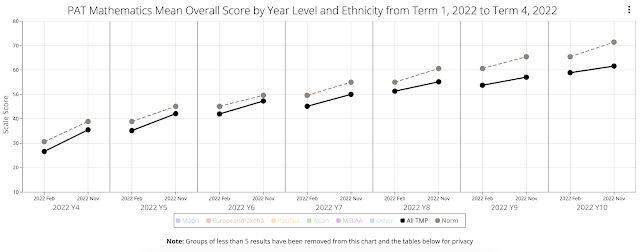
Maths is complex we all know that. There is number knowledge, strand, apply the knowledge we have learned. When exploring the wider Data from PAT test in our school, cluster and wider Makaiakalani community we can see that for us in our school their is a significant challenge. 

Graph 1: Pt England School: 

As you can see from this graph well the children look to be travelling along the same trajectory as the norm the gap between the norm and children at our school at all levels in significant. 

Graph 2: Manaiakalani Cluster:

While this paints a lightly more positive picture it is clear that at year 9 and 10 the gap widens and that there is still a difference between the data and norm. 

Graph 3: The Manaiakalani Programs 


Similarly to the data is closer to the norm but still shows that there is a gap widening at year 7-10. 

What does this say about the problem? We can see that the wide range of knowledge, strategy and application required in Mathematics are not being gain by all children and that on the whole there is a significant gap between the the norm and especially where the children are at our school. 

Friday, 17 February 2023

Inquiring a New Year = New opportunities

What a time we live in!

We have had so much anxiety, we have fought to survive as teacher, learners and humans. 

We had faced Covid 19 and as we hoped for a more normal year where children did not have to face the same anxiety and challenges. 

With the recent floods many people are unsettled but learners and teachers alike are eager, excited and ready for 2023. 

As teachers we are always learning. We are know a lot and try new things but with out efficiency and routine we end up frustrated and feel unheard. But.... there is a balance when routine is all you do life and learning get very boring. 

As we inquiry we need to think about how we become adaptive experts. How do we build on what we learned last year, change, adapt, develop and make learning something everyone in the room enjoys and wants to do. 

This week I have been thinking about this idea a lot. I have been trying new things trying to be more of a record keeper. 

One thing I have attempted this week is using a digital modelling book as a guide for both my lesson and for children to reflect back on. 


What I loved about this was not the writing a modelling book but the way in which the children reflected on what they know about with reading and writing. 

Being an adaptive expert means being aware of the environment and situation around us and know what we can do to optimise these. I like everyone you can just be an expert you have to keep developing, keep calm and TRY!

How can we be the people who are, calm, encourage, supportive and help children feel safe in this world that is forever changing and at sometimes fraught with danger. Is it about helping children feel informed and aware, be partners in learning and know that they can always seek help and that we are all humans and make mistakes.  


Planning for effective inquiry

What is real for the kids we are teaching right now? 
What is manageable? 
How will my question develop to meet the needs of my class. 


Thursday, 16 February 2023

Meet the CoL Across School Teachers

 We are so privileged to have wonderful experts in our community. These wonderful Across School Teachers are support kind teachers who are her to help us.

Elena

Is a wonderful year 3 teacher at Glen Taylor School. She has challenged herself and put herself out there as a class OnAir teacher. She loves maths and intergrating the Curriculum. I encourage you to connect with her and check out her Blog

Danni 

In the past Danni has support many people in the past and I myself have often gone to her for support. She has inquired into many area but has a special interest in teaching reading. You can watch her wonderful teaching on Manaiakalani Class OnAir and learn more about her on her blog

Scott

Is a wonderful high school teacher. He is in-charge of history at his school. He is happy to support teacher with the New Zealand Histories curriculum. He discuss how children are under a lot of pressure to move from one topic to the next. Can we integrate and collaborated to make learning more relevant for learners and their real lives. Learn more about him on his blog

Amy 

Is a wonderful year 7/8 teacher who has worked hard to develop project based learning and a culture of talk, discussion and positivity through a number of inquires. I love hearing her ideas and encourage you to think about how you might reach out and connect with her on her blog.  

What amazing people. I will definitely be connecting with the people along with many other CoL teachers as I work to develop inquiry and grow as a teacher in 2023. 

Wednesday, 15 February 2023

My class

 The start to 2023 has been anything but normal, with storms raging across New Zealand meaning a later start to the year then planned and the school closing for a day so that we could all stay safe. 

Another surprise which perhaps shouldn't have been a surprise coming off 2022 was the way in which my class jumped straight into learning, talking, sharing ideas and pushing themselves to both complete set tasks and extend their thinking. 

With this exciting development I have started to rethink my inquiry focus. In 2022 I was thinking of focusing on reading specifically critical and collaborative literacy. As a look around the room in week 2 of the term I can already see these elements developing from my current practice. As such I wonder whether this focus is needed. 


As I reflect on the conversational groups I see and the details in literacy I am reminded of the stark contrast with mathematics in my room. During maths time children appear to be less collaborative and see maths as less of a discussion and more of an independent activity.  

As such I am beginning to question which approach would be most beneficial to my learners this year. 

In saying this no matter which approach I take I want the goal for learning to be around collaboration and critical thinking and for my inquiry to no longer be a solo endeavour but rather a collaborative quest in which the burden and rewards are shared. 


Tuesday, 22 November 2022

Looking forward to 2023


As I reflect on 2022 as a year I look back to see many positive, many Challenges and many possible next steps forward for myself as a teacher and the learners I teach. While Literacy as not been an inquiry focus for me this year I realise that critical and collaborative literacy are areas that has not been as central to my practice as I would like. 


What achievement challenge are you considering as an area of focus in 2023 and why? Include in your WHY both evidence and your own passion/expertise? 

As a result I would like to focus again on Achievement Challenge 3:  Lift the achievement in Reading for all students, with a particular focus on boys and Māori students (both genders) years 1-13 with a specific focus on critical literacy and collaboration. 

While I have many able reader in my class this year the area in which they struggled most has been making connections between text, connecting what they read to their own experiences and asking questions about the author and reliability of the texts they read. This was reflected in group discussions. 

I am passion about this as I know that being inquisitive, critical, collaborative and thoughtful helps children to create and share in a way that is meaningful for them and help them to build a strong understand of the world around them. 


What learnings from the 2017 - 2022 CoL teacher inquiries have informed or inspired your thinking.

There have been so many wonderful inquires into the area of reading and within the cluster there are many amazing resources. 
Two inquiry on Robyns inspired me and provide a great spring board. In 2019 she looked into comprehension strategies in reading and this year the enjoyment of reading. 
Another inquiry that has influenced my thinking has been Hannah West inquiry looking the at impact of vocabulary last year. This connected closely to my own inquiry in 2020 and we both found that vocabulary played a huge role in literacy achievement. 
This year Jo Gormly inquiry around vocabulary was also inspiring for me. It puts into perspective the ideas that teachers have a responsibility to gift model and support the language they expect from learner, Which I believe could be a key fact in forming the collaborative and critical in the classroom and way of engaging with each other. 

How would your work support Manaiakalani pedagogy and  kaupapa?

There ware many ways this focus would connect and support the Manaiakalani pedagogy:
  • It reflects the values of learn, create and share. 
  • It connects to the valued reading practices that a known to get shift for learners. 
  • Skills for learning that are transferable across the curriculum. 
  • Collaboration 
  • Most of all it focus on supporting connected and empowered learners. 

Which elements of the extensive Manaiakalani research findings inform or challenge you as you think about this?
This is support by the research from Manaiaklani surveys around reading and high leverage practices. Both Collaboration and critical thinking are points that have regularly been discussed drawing on Manaiakalani research but also wider research. 
Some examples of this research are:

How would you like to be supported in 2023 as you undertake this inquiry?

In 2023 I would like to connect more in my inquiry. It has been great being back together this year and having the time to talk and discuss. In 2023 I would like to actively collaborate in the creation of tools to access progress and interventions with others who have a similar interests and whose learners have similar needs. 
I also great value and will continue to rely on the many experts in the Manaiakalni team. 

How would you plan to support your colleagues in your school with THEIR inquiries and/or teaching in the area you are exploring?

I and I feel anyone who know me would agree love to share and discuss. I think this is the way in which I will most benefit and support others in my inquires in 2023. I also love to listen to others ideas and have in my years in as a CoL leader heard many ideas of others and pointed people to research, blogs or other teacher who might support them.