Showing posts with label -Dr Jannie van Hees. Show all posts

Monday, 16 March 2020

Focusing Inquiry for 2020

I have been thinking a lot over the past 3 months about my inquiry from last year. How much I learned as a teacher and the shifts I saw in the children's attitudes and ability.

What I know for sure is that there is so much more I need to learn. So much more value I could be bring to my classroom to address the gaps in vocabulary. As I began to discuss this with others in my school I released that I needed to maintain the literacy focus in had in 2019 and build on this.

I began to read the wonderful book by Dr Jannie van Hees and Paul Nation- What every primary school teacher should know about vocabulary.
Image result for What every primary school teacher should know about vocabulary.

This a long with discussion with my SMT team and teaching colleges helped me to develop my questions that will guide my thinking around my inquiry this year leading from reading to oral language and hopefully into written language as the year progress.

Will increase discussion between learners and deliberate acts of teaching vocabulary improve achievement across multiple curriculum areas? 

My plan is to be more specific in my thinking, planning and implementation of my intervention this year giving my approach more time to work.


Thursday, 21 November 2019

Bursts and Bubble Reflecting on my inquiry

I am excited to share my inquiry in 3 minutes at our Bursts and Bubbles. Thought, Idea, Innovation, Imagination, Inspiration


The catalytic aspect of student learning for my inquiry was gifting vocabulary across my literacy program in an effort to increase overall literacy achievement for my learners.


I identified this as my focus when I noticed that while the cluster wide and school wide data showed a need to focus on improving reading many of the learner in my learning space were struggling writer coming into year 3 writing at a 1B level.


The sources of evidence and data I used were from both the areas of interest for me and my learners. I used Star Reading data, Running records, e-asstle writing data, samples of writing taken from the learners writing books as well as my own observational notes of students reading and writing behaviours.

The main patterns of student learning I identified in the profiling phase were that learners were writing very short stories that were lacking in the areas of ideas and organisation. They also struggled with decoding in reading with all 11 learners in my target groups reading at a year 1 level. While they were eager learners they often struggled to get started and to attempt unknown words in both reading and writing.


My profiling of my own teaching looking back at previous years data showed that I made  good progress in reading using my current approach. I noted however that when teaching writing I was not gifting the amount of language I suspected was enough to support vocabulary acquisition and retention in reading or writing.  This led me to think carefully about the gifting process in my teaching when the introduction of texts for reading, engaging learners in a writing experience and throughout the writing process.


The changes I made in my teaching were carefully selecting language when introducing learners to their texts in reading. I also worked on intentionally gifting language throughout the writing process and making this rewindable the use of audio clips in the explain thing activities. During my implementation I notice that writing was still short and that sight word writing was holding learners back. This is when I worked on building automaticity of sight words in context.


The literature/expertise that mostly helped me decide what changes to make were looking back at the inquiries in this area conducted by others in the past. I also drew on the professional learning from Jannie Van Hees and took the ideas she shared in CoL meeting and team meeting into my practice.


Overall I would rate the changes in student learning as interesting The evidence for this is that student achievement in reading was great with all but 2 learners making over a years progress and 2 learners making over 2 years progress. This is significant for these learners when compared their progress in previous year. While learners writing length increase this did not translate into shifts in writing level on the e-asttle test. I wonder if more regularity in implementation of approach would change the impact. 

Saturday, 16 November 2019

Reflect on your professional learning

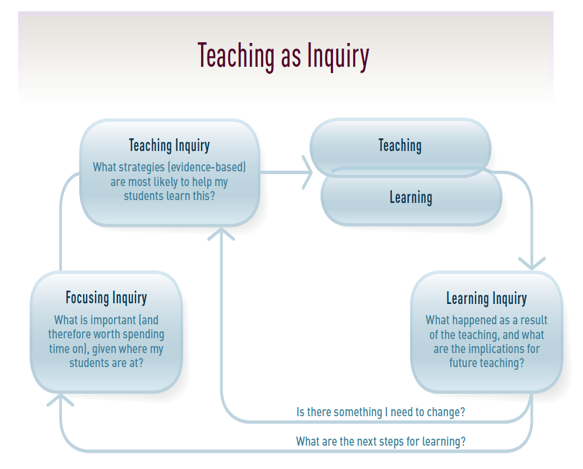
Image result for teaching as inquiry
4. Write a reflection on your own professional learning through this inquiry cycle.

This inquiry has been a big cycle of learning for me. I have found myself asking many question like:
-Why is my reading shifting at a rate much faster then my writing?
-Why has my change practice not had the impact I had hope?
-How much time did I really spend on my changed practice and was it enough?

This inquiry as made me go back and think carefully about the practice that I may have lost over the years. I has also made me reflect on the most important parts of the writing and reading cycles.

To do this I have looked at the effective literacy practice books year 1-4. This lead me to change my practice and work more on who was writing. This was a key idea of Dr Jannie van Hees when she talked to us about the apprenticeship also.

I have learned a lot about what doesn't work also. The main thing I have found is that too much change too fast does not affect the change. In the future I want to be careful about all the elements I change and maintain the change over a longer period of time with more careful and close reflection on each individual element.

I also reflected that my classroom trend is different from that of the cluster data. I wondered if perhaps I need to draw on more experts within the cluster to change my practice. Perhaps more data gathering would be of benefit. I wonder how to best locate teacher in year 1-3 making significant shift in writing.

This inquiry has lead be to believe I still have a lot of work to do in my practice and as I reflect and discuss this challenge with many of my colleagues.

Friday, 15 November 2019

Overall evaluation of your intervention

3. Write an overall evaluation of your intervention in terms of the causal chain you had theorised. i.e. To what extent was the intervention successful in changing factors such as teaching? To what extent were those changes in teaching effective in changing patterns of student learning?

Early in my inquiry I identified two key changes and theorised that impact of these changes see this blog post.

While I made these changes I found that due to a number of factors including, time in the classroom, changes of classroom teachers and inconsistency in my ability to regularly deliver these changed practices caused a lack of repetition in my approach.  From my earlier inquiries including my 2016-2017 inquiry into reading fluency. I know that consistency and repetition of a teaching approach are important in creating learner growth.

While I wouldn't say my intervention failed I believe I did not give it a change to really succeed. While some of the factors that prevented this were beyond my control such as my co-teacher leaving, many were factors I should have had more control over. In future I will implement my intervention earlier and monitor myself better. For example making notes of how regularly I implemented each element and giving each element more time to work.


Thursday, 14 November 2019

The Key changes I have made in my inquiry

1. Summarise evidence about key changes in teaching and other factors that influence student learning.

At the beginning of the year it was clear that there was a huge need for my learners in writing and reading. See this blog post.

This need lead me to look at my practice and think about what I was doing and what changes needed to be made to address the clear need in the data. As a result I tried a number of different practice aimed at building vocabulary in literacy and building writing capacity and skill.

As a result I tried a number of different things. Looking back perhaps to many different things and nothing for quite long enough but my practice definitely changed.

Each term I made a change based on reflections on student engagement, data and need.


Early in the year, Chrissy and I worked together with a focus on building oral language and written language through connection of reading and writing with a strong focus on oral record. We did this by focusing on an element of text, setting, character and plot for 1-2 week blocks and this being the main focus of all reading and writing with an aim of building descriptive language around each element.


This is an example of the children's created character and shares the same feature as the reading activity. 


Here are some example of what this looked like. We found that well the language used within their activities was similar to that they already had and that this was not maximising gifted language the way we had hope. Gifted language was used more in writing however.


Also in Term 2 (See blog post) I looked at how I could gift more language using the digital technologies. I found myself over gifting which and the learners were so overwhelmed. I learned from this experience.

In Term 3 we had some wonderful team professional development with Dr Jannie van Hees this made me think about the things that are missing in my program. What am I doing about sight words. I started using this approach and the kids said "I like writing the little word." "I write more this time."

I also filmed this lesson for my Manaiakalani Google Class Onair.

Friday, 12 April 2019

Pekky The Pukeko

There are many sources of spoken language, song, stories, videos, face-face communication, poems and so much more. 

The uptake potential is different for our children, digital interaction with has less uptake than the face to face interactions that have a social context.


We then discussed this text and the key ideas breaking it down and identify the vocabulary groups we we would discuss with the children. We talked about the ways this could become a much larger piece of learning. 

Some of the vocabulary we discussed, boisterous, engaged in play, favourite place to play, tugged on the laces, powerful red beak. 

We want children to understand that words keep company with each other because words have power and if we gift words in group children will know to use them in groups in way that make meaning. 

Words have Power Part 2

Today we had Dr Jannie van Hees visiting us again today. 

The number of text the are in children lives is a huge factor is achievement, we know this from a number of resources. These texts however are best when they are accompanied by talk. We also need to be aware of the language we use with kids, if we keep puddling around it simple texts spoken, written and visual then all kids will know is simple texts. No matter the age or stage children need to be exposed to lots of texts that are too hard for them. 

What does this mean for our PM text that are simple in their nature that we use to teach students to read. Is there a different way of looking at this but not throwing out what we know. We can't just have kids repeating what they know we must move them beyond what they already know. 

Children have an outstanding capacity to learn, we must never be afraid to push children to work at a level they can't do it on their own. 

A question we must ask ourselves: How much time are we spending pulling from the kids and how much time are we spending gifting. 

Jannie then reminded us of the conditions we want for learning. She suggest that an encourager should happen 3-6 times with the teacher has a higher likelihood of up take. Jannie talked about putting the effort back on the kids and using specific feedback. 

We need to deep dive into the text, it is not to say we need lots of activities but that we need time and quality conversation to really truely build understanding. 

Talking with detail is a major change maker for our kids. Learners need to know they have to dig deep and that the expectation in the classroom is that we share in detail. We want the children in our class to talk to us the whole class not just the teacher. We need to work on how our children talk to everyone. We are sharing our thinking is because we learn together. 

No matter what we value each others contribution!
The teacher is a major scaffolder, however children can be great scaffolders if we scaffold their scaffolding and families can be scaffolder also. 

We want kids to talk the detail and expand our ideas. 

We want to stop saying it is more interesting, We want to say because you used more detail that your audience know what you mean. 


We must have a mantra as a teacher: I will alway offer vocabulary that talks the detail and say thing they would not normally utter. 

We need to get children to unlazy their brain, don't use the easy word because you have another word. 

We must keep thinking gifting, gifting, gifting. 

Thursday, 21 March 2019

Words Have Power

Dr Jannie van Hees reminded us of the need of all our learners in terms of vocabulary acquisition.

What are some of the things we are noticing:
-Fluency-Concertation
-Knowledge gap
-Writing like talk not crafted
-High demands texts.

We must remember that language is oral and print and within that sit the vocabulary. Just because students are exposed to language does not mean they will up take that language.

They need:
FOCUS and NOTICE
Put in the effort
Take part (participate) fully
Push myself to the edge 
Dig deep for what I already know
Learn from others – notice and focus
I share – others gain from me
Think and talk; think and read
WONDERING and ASKING opens up possibilities to know

These conditions need to be normalised in the classroom and be part of everyday. 

We must think, Where is the languaging of the learning in my inquiry?

We want students to extend their ideas beyond just one simple idea. We want them to add detail and this is only done through practice. When students have more pair talk and shared talk, challenges and models of how to offer more language. 

How can we make the environment more dialogic? How much sharing can I make happen in a day?


Jan suggested we need quantity of quality.

We should be thinking about the texts about the world that are current and interesting for the learners and how we can build language in a meaningful way. 

One way Jan did was by using fluency to help build understanding. She did this by chucking the text by putting breaks between ideas. 

There are so many quality texts out there the challenge is to do quality and quantity. 


Monday, 7 May 2018

Language in Abundance-Dr Jannie van Hees

We know that language come in the forms of spoken and written. We must remember that both forms of language are important. We make sure our learners are exposed to a number of novel text that engage learners in a new meaningful vocabulary and grammar structures.

We are talking about Optimising Learning Conditions of Language.

Students need others language available to them. Students trying out language.
We often get a lot of language from children and this is coming at the expense of others providing meaningful language that then limits what they can draw on.

All the things we know we have learnt from others. We have had loads of exposure to language and to the knew. We need to gift them new in noticing ways. We often dig and dig into students prior knowledge we need to shift our focus to build. We should be gifting 60/40 extracting.

These are the three key ideas in building language learning.

Focus 1: Optimising learning and interactional conditions.
Focus 2: Elaborative style to pedagogical responses.
Focus 3: Scaffolding Learners to become effective conversationalists.
Focus 4: Planning, Preparing, Providing

We as teachers need to make sure these three focuses are active in this learning. We need to catch the learners and make sure that engagement is happening. We can go this through more and more peer sharing.

I believe that this is something that I have to do more of. We need to have high expectations.

The learner has to make responsibility as well they have to be attending. They have to put in the effort.

We want to make sure that students see and feel they are support each others learning.

Before engaging learners in video content you may remind them of the learner conditions Notice and Focus and tell them to caught what you can. When using video a lot of the language is not always noticed. Providing a transcript and using multimodal and foregrounding the language and they are involved in the language.